
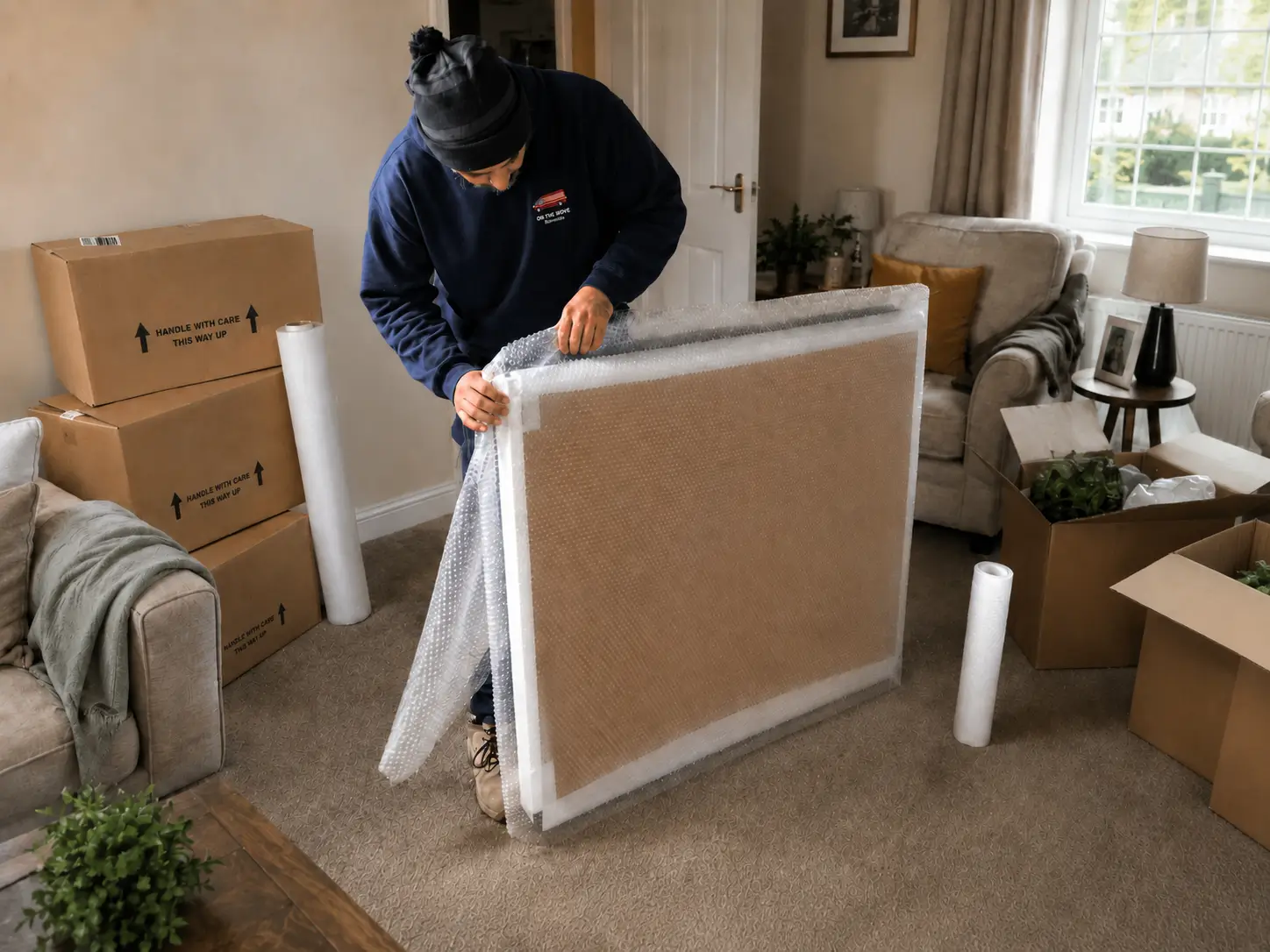
Most TVs break during a move for one boring reason: they are treated like furniture when they should be treated like glass. A modern flat screen looks solid from the sofa, but the panel is thin, the corners are vulnerable, and the screen hates pressure across the middle.
Here is the practical way to pack a TV so it survives the journey.
Start with the safest option
If you still have the original TV box, use it. The foam inserts were shaped for that exact screen, and nothing you make from spare cardboard will fit quite as well.
If the original box has gone, you can still move the TV safely. You just need four layers of protection:
- screen protection
- corner protection
- outer wrap
- upright loading
That last one matters. A TV should travel upright, not flat. Flat screens do not like weight pressing across the panel, even if the weight is only a blanket and a couple of light boxes.
For a real price for your specific move, the quickest path is to WhatsApp Shaun, call 07873 405 938, or email onthemove89@gmail.com. For Huddersfield-area moves Shaun can usually visit in person and check large TVs, mirrors, pictures, and awkward furniture before quoting.
Take a photo before you unplug anything
Before you remove a cable, take a clear photo of the back of the TV. It saves a lot of fiddling at the new house, especially if the TV has a soundbar, games console, aerial, streaming box, or wall bracket attached.
Then remove:
- power cable
- HDMI cables
- aerial cable
- soundbar cable
- streaming sticks
- games console cables
- wall bracket arms if they are detachable
Put cables and remotes in a labelled bag or small box. Do not tape them to the TV. Loose plugs can scratch the back of the screen, and taped cables are easy to pull or bend when someone lifts the set.
Protect the screen first
The screen needs a clean, flat shield before the bubble wrap goes on. Good options:
- foam sheet from a packing supplier
- clean cardboard cut slightly larger than the screen
- a proper TV screen protector
- the original foam sheet if you kept it
Do not put tape directly on the screen. Do not put tape on the thin black bezel either if you can avoid it. Tape the screen shield to the outer bubble wrap, or wrap the TV tightly enough that the shield stays in place.
This is the step people skip. Bubble wrap helps with knocks, but it does not spread pressure across the screen as well as a firm cardboard or foam panel.
Wrap the corners properly
TV corners crack first. They catch door frames, bannisters, van sides, and the edges of other furniture.
If you have foam corner protectors, use them. If not, fold cardboard into corner guards and tape them around the outer wrap. Add extra bubble wrap around all four corners before you wrap the full screen.
Two thin layers across the whole TV are useful. Four or five extra layers on each corner are better.
Bubble-wrap the whole TV
Once the screen shield and corners are covered, wrap the whole TV in bubble wrap. Keep the bubbles facing inward if the wrap will touch the TV surface, because that gives a softer cushion.
Use enough wrap that the TV no longer feels like a hard, bare object. You are trying to protect against:
- door-frame knocks
- stair-wall brushes
- van vibration
- pressure from nearby items
- fingers gripping the screen edge by mistake
Tape the bubble wrap to itself. If you are worried the tape may touch the TV when the wrap shifts, add a plain paper layer or cloth layer first.
For more general fragile-item protection, see our guide to packing fragile items for a move.
If you have a wall-mounted TV
Wall-mounted TVs need a bit more care because there are usually metal bracket arms on the back.
Remove the TV from the wall before the removal team arrives if you can do it safely. If the TV is large, ask for help. Two people should lift it off the bracket, one at each side, with no pressure on the screen.
Put the bracket screws into a labelled bag. Tape that bag to the wall bracket or put it in your essentials box. If the bracket is moving with you, wrap it separately. Metal brackets can scratch furniture and screens if they are left loose.
If you are not comfortable removing the TV from the wall, mention it when you ask for the quote. It is much better to plan the time than discover it at 8am with the van outside.
How we load TVs on the van
On a professional move, the TV normally goes on late, after the heavy furniture is already loaded and secured. That way it is not trapped behind wardrobes, beds, and boxes.
We keep TVs upright and protected, usually between soft, flat items or against a stable side section of the load. We do not lay boxes across the screen, and we do not let a TV bounce around loose at the back of the van.
That is also why it helps to tell Shaun about the TV during the quote. A 32-inch spare-room TV is one thing. A 77-inch OLED is another. Both can be moved safely, but they need different space in the load.
For full-house moves, see how our house removals work. If your move is mainly a few delicate or bulky items, single item removals may be the better fit.
Common mistakes that crack screens
The most common TV packing mistakes are simple:
- laying the TV flat in a car boot
- packing the TV under duvets and hoping for the best
- carrying it by the screen edge
- leaving the pedestal stand attached when it makes the TV unstable
- taping bubble wrap directly to the screen
- loading boxes against the middle of the panel
- forgetting the wall bracket until moving morning
The worst one is treating a wrapped TV as if it is now unbreakable. Wrapping buys you protection. It does not make the screen strong.
What to do at the new house
Do not plug the TV in straight away if it has been sitting in a cold van and the new house is warm. Let it settle for a short while, especially in winter, so condensation is not trapped around the electronics.
Check the screen before you throw away the wrapping. Look for cracks, pressure marks, or corner damage. Then use your cable photo to reconnect everything without guessing.
If you are putting the TV back on the wall, check the wall type before drilling. New-build plasterboard, old stone walls, chimney breasts, and dot-and-dab walls all need different fixings. A TV that survived the move should not lose the argument with the wall a week later.
When to let the removals team handle it
Pack it yourself if you have time, materials, and a sensible route from room to van.
Ask for help if:
- the TV is over 55 inches
- it is OLED, very thin, or expensive
- it is wall-mounted
- stairs or turns are tight
- you no longer have the stand
- you are already using a packing service
Our packing services can cover TVs, mirrors, pictures, glassware, and awkward fragile items. Or, if you just want advice before the day, ask Shaun during the quote. The answer may simply be: leave that one for us.
Frequently Asked Questions
Can I move a TV without the original box?
Should a TV be moved flat or upright?
Can I tape bubble wrap directly to the TV?
Will On The Move Removals protect TVs during a house move?
What size TV needs special care?
Keep reading

How to Pack Glassware for Moving Without Breakages
A practical guide to packing glasses, mugs, bowls, plates, and fragile kitchen items for a move, with box choice and wrapping tips.

How to Prep Your Furniture So the Move Costs Less
Empty drawers, never gaffer-tape, bubble-wrap mirrors and TVs. The furniture-prep we ask customers to do before our crew arrives, and why it saves real money.