
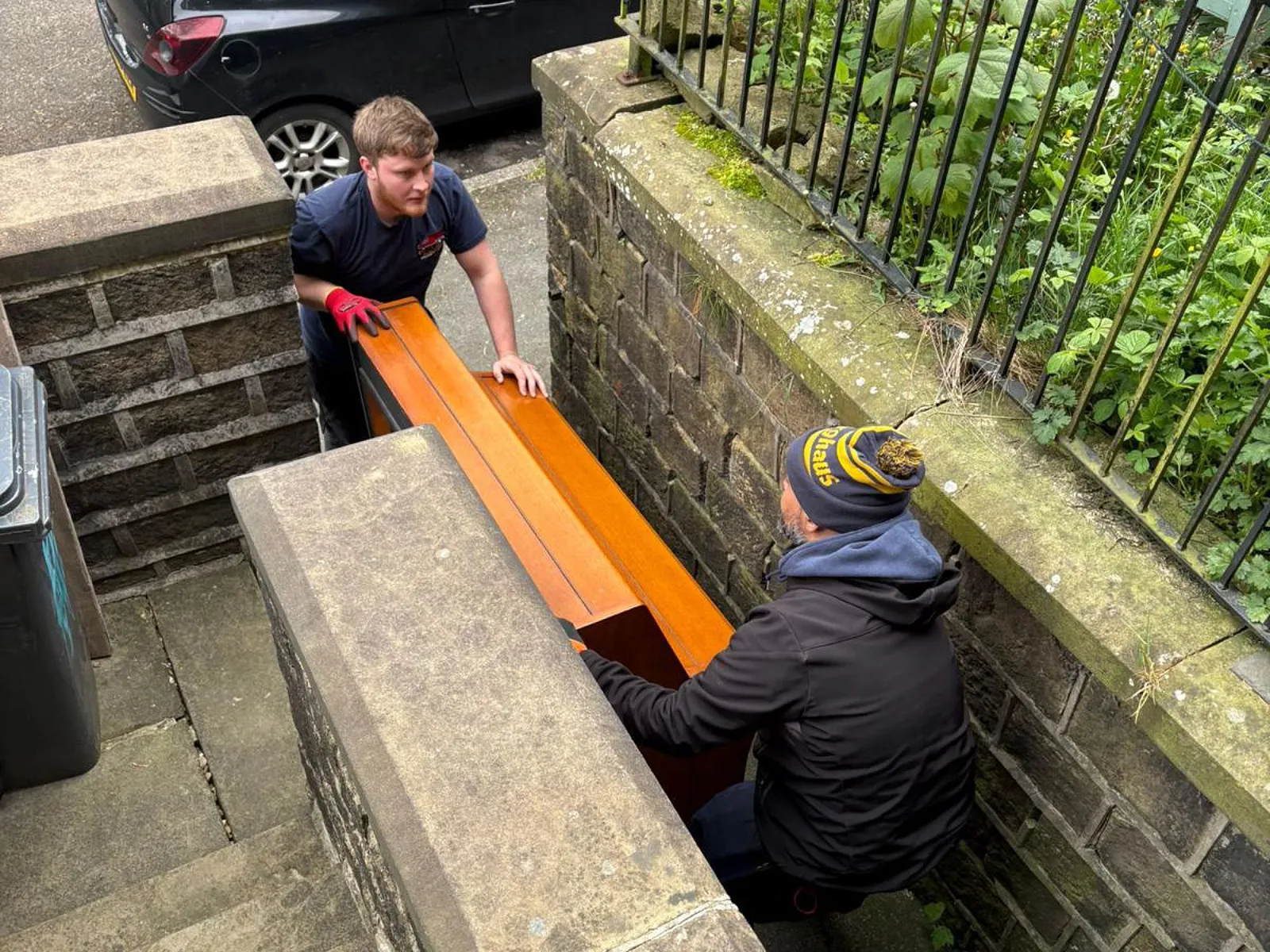
The most common piano damage we see isn't a dropped piano. It's a piano that survived the move physically but came out with a cracked case from rope marks, a loose hammer assembly from a hard knock, or a leg that shifted because someone tried to lift by it. The piano's still playable. It's also worth a few hundred pounds less than it was on Monday.
How to move a piano without wrecking it comes down to understanding three things: where its weight actually sits, what kills the case during transit, and which moments cause real damage.
For a real price for your specific piano move, the quickest path is a free, no-obligation quote. WhatsApp us or call 07873 405 938 with the make and model and a few photos of the access at both ends, and we'll turn a price around quickly with no sales pressure afterwards.
Pianos aren't as heavy as you think. They're awkward.
A typical upright piano weighs between 180kg and 280kg. A baby grand is about 230kg to 300kg. A full concert grand is 480kg to 550kg.
180kg sounds heavy. It is. But two strong adults can bear that weight on a flat hard surface for short distances. The problem is never the weight, it's that:
- 70% of an upright piano's mass sits in the back panel and the cast-iron frame, not distributed evenly
- The "lifting points" most people instinctively grab (the legs, the music desk, the keyboard lid) are decorative, not structural
- A piano dropped onto a corner can crack the soundboard permanently
Knowing where the mass actually is changes everything about how you move it.
The three things that actually break pianos
1. Tipping during the lift
Two people lifting a piano off a flat floor often work it: knees bent, lift from the bottom edge, walk it to the dolly. What goes wrong is the rotation. The instinctive lift to "get it onto the dolly" tilts the piano forward, inertia keeps it tilting, and suddenly 70% of 200kg is going past your grip.
A piano that tips even 30 degrees while being lifted by two people will land on its corner. That corner now has a fractured case at minimum, and possibly a misaligned action inside.
The fix: a tilt is fine if it's controlled. Three people, never two, when the piano is leaving the floor. Two on the front carrying the weight, one behind controlling the rotation.
2. The walk-down on steps and ramps
Stone steps, slate steps, garden paths with kerbs, the threshold between hallway and living room. Anywhere the piano needs to descend even one step is the second most common damage point.
The reason is gravity. On a step, the piano wants to slide down faster than the people carrying it. If they're not braced for that surge, the bottom edge catches the step lip, and the case takes the impact.
The fix: stair-climber dollies exist for a reason. We use one with an anti-slip strap rated for piano weight. We don't carry pianos down anything more than a single step without it.
3. Wrapping that doesn't actually protect
Bubble wrap on its own is useless for piano transport. It compresses to nothing under sustained pressure and slides around inside its own envelope. By the second corner of a tight hallway, your bubble wrap has shifted to the wrong side of the piano.
The fix: heavy moving blankets, secured with proper webbing straps, not cling film or rope. Cling film traps moisture against the wood. Rope cuts into the case under tension and leaves permanent marks on a polished finish.
We supply calico-lined moving blankets specifically for piano work. They're heavier, don't bunch up, and don't trap humidity.
When a piano move is genuinely DIY-able
Honest answer: a digital piano or stage keyboard. The case is plastic, the weight is 30kg to 50kg, and there's no acoustic action to misalign. Wrap it in a blanket, lift with two people, treat the keys themselves as the most fragile part. Done.
Acoustic uprights and grands are not DIY for most people. Not because the lift is impossible (it isn't), but because the cost of a single mistake exceeds what professional removal would cost in the first place.
A modest upright piano costs about £600 to £1,500 to replace. A serviceable grand starts around £3,000 and climbs fast. The cost of a specialist piano move with two trained crew is from £150 for an upright locally, more for grands or harder access. The maths usually does itself.
What we charge for piano removals
For most uprights moving locally in West Yorkshire, our piano move starts from £150. The price reflects the equipment (specialist dolly, stair-climber, calico blankets, webbing), and the fact that we always send two trained crew minimum, three for any access with steps.
A baby grand is more, typically £250 to £400 depending on access and distance. A nationwide piano move is quoted per job because the route, the access at both ends, and any storage between are the real variables.
You can see all our piano removal service details on the dedicated page.
The questions worth asking before booking anyone
If you call a removal company that says they "can do pianos as part of a regular house move," ask:
- "How many pianos have you moved this year?" Specific number, not "loads."
- "Do you use a dedicated piano dolly or a regular furniture dolly?" The difference matters.
- "What's your insurance position if you damage the piano?" Goods-in-transit cover should specifically apply. Some policies exclude pianos.
- "Will the same crew do both ends?" Subcontracting on a piano move is a yellow flag.
If the answer to any of those is vague, the piano isn't a normal job for them and you should keep looking. Our questions to ask before booking article goes into more on this.
Our honest advice
Most piano damage we see in West Yorkshire wasn't done by professionals. It was done by people who tried hard, had the right intention, and got bitten by one of the three things above.
If your piano has any sentimental or financial value, the £150 starting price for an upright move is real value. If it's a beat-up old upright you wouldn't be sad to lose, then yes, sometimes a careful DIY with three people, a dolly, and proper blankets works fine.
For anything in between, get a quote. Our piano removal service is staffed by the same crew that does our house removals, so you're not handing the job to a stranger.
Frequently Asked Questions
How much does it cost to move a piano in the UK?
Can two people move an upright piano?
Will my piano need re-tuning after a move?
Can you move a piano up stairs?
Keep reading

Moving an Older Relative in Kirklees: A Practical Family Guide
A careful guide to moving an older parent or relative in Kirklees, covering planning, downsizing, access, storage, and the move-day pace.
Why Our WhatsApp Quote Videos Are Pre-Recorded, Not Live
When an in-person quote isn't possible, we ask for a pre-recorded WhatsApp removal quote video rather than a live call. How it works, why pre-recorded, and what to film.